Sidequest: Planeten
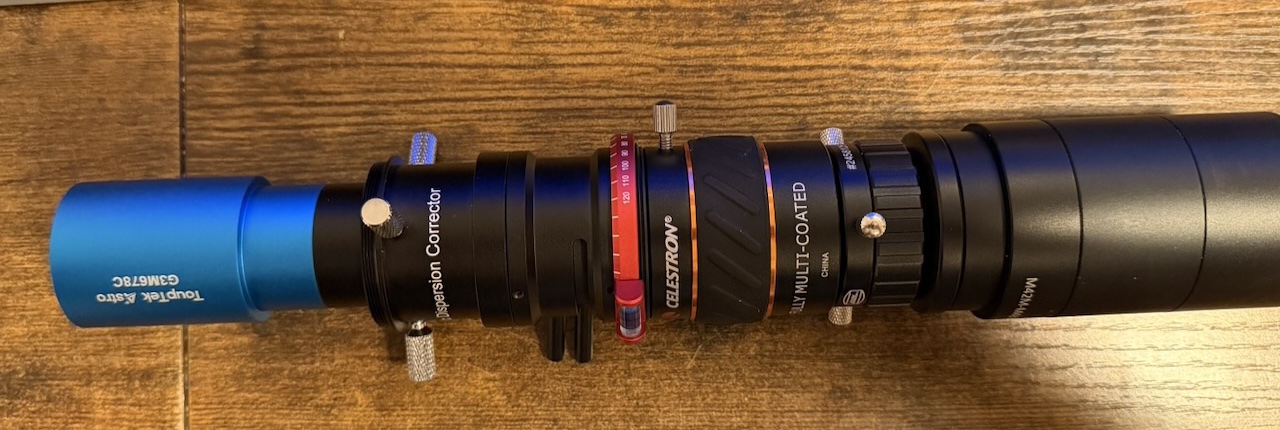
Meistens fotografiere ich hier Nebel und Galaxien. Das heißt: schwache Objekte, Belichtungen von fünf Minuten, viele Stunden pro Bild. Planeten sind das genaue Gegenteil. Sie sind hell, winzig und die eigentliche Aufnahme dauert Sekunden. Dafür braucht es andere Technik, und die liegt jetzt auf meinem Tisch. Ein Nebenprojekt, eine Sidequest.
Der erste Versuch
Ganz neu ist das Thema nicht. Im Januar 2025 habe ich Jupiter schon einmal aufgenommen, mit meiner normalen Kamera, der ZWO ASI071MC Pro. In SharpCap habe ich dafür nur einen Ausschnitt von 1600 × 1200 Pixeln ausgelesen. Ein Video aus dieser Nacht hat 285 Einzelbilder in 25 Sekunden: 87 Millisekunden pro Bild, 11,5 Bilder pro Sekunde.
Für Nebel ist die Kamera gut. Für Planeten passt sie nicht. Die Luft über dem Teleskop ist ständig in Bewegung, und das Bild eines Planeten wabert im Takt von wenigen Millisekunden. Bei 87 Millisekunden steckt in jedem Einzelbild schon eine ganze Menge dieser Bewegung, und feine Details verschwimmen. Dazu sind die Pixel der ASI071 mit 4,78 µm groß, ein Planet bleibt darauf ein kleines Scheibchen.
Lucky Imaging
Planetenfotos entstehen anders als Nebelbilder. Man nimmt ein Video mit tausenden sehr kurzen Einzelbildern auf. In manchen Momenten ist die Luft zufällig ruhig, und genau diese Bilder sind scharf. Ein Programm wie AutoStakkert sucht die besten heraus und rechnet sie zusammen. Das nennt sich Lucky Imaging. Je kürzer die Belichtung und je mehr Bilder pro Sekunde, desto mehr Glückstreffer.
Eine Sache habe ich beim Mond gelernt: Lange Serien helfen nicht. Damals habe ich Einzelbilder über gut zwei Minuten verteilt aufgenommen. Die ersten 26 Sekunden waren sauber, die ganze Serie zusammen war verschmiert, weil sich die Luft in der Zwischenzeit verändert hatte. Lieber mehrere kurze Videos als ein langes.
Der Aufbau
Auf dem Foto liegt der Kamerazug von rechts nach links, so wie das Licht durch ihn läuft.
Teleskop: 8-Zoll-SCT ohne Reducer
Für Nebel sitzt am Celestron 8" ein Reducer. Er verkürzt die Brennweite auf 1440 mm und macht das Bildfeld größer. Für Planeten brauche ich das Gegenteil, also kommt der Reducer heraus. Dann arbeitet das Teleskop mit seiner vollen Brennweite von 2032 mm bei f/10.
Celestron X-Cel LX Barlow 2×
Die Barlowlinse verlängert die Brennweite noch einmal auf rund 4000 mm, f/20. Der Planet wird damit auf dem Sensor doppelt so groß.
Dispersionskorrektor (ADC)
Die Lufthülle wirkt wie ein schwaches Prisma. Sie bricht blaues Licht etwas stärker als rotes. Ein tief stehender Planet bekommt dadurch einen blauen Saum an der einen Seite und einen roten an der anderen, und die Farbkanäle liegen nicht mehr übereinander. Das kostet Schärfe.
Hier oben auf 54 Grad Nord stehen die Planeten oft niedrig. Saturn kommt derzeit kaum über 40 Grad Höhe. Der ADC enthält zwei Prismen, die man gegeneinander verdreht, bis sie den Farbfehler der Luft gerade aufheben. Die rote Skala zeigt dabei den Winkel an. Je tiefer der Planet steht, desto weiter muss man die Prismen auseinanderdrehen.
ToupTek G3M678C
Die blaue Kamera links ist eine reine Planetenkamera. Sie hat einen Sony-IMX678-Farbsensor mit 3840 × 2160 Pixeln von je 2,0 µm. Das Ausleserauschen ist sehr gering, und mit einem kleinen Ausschnitt liefert sie hunderte Bilder pro Sekunde. Eine Kühlung hat sie nicht. Das braucht sie auch nicht, weil bei Belichtungen von wenigen Millisekunden kaum Wärmerauschen entsteht.
Ein bisschen Rechnen
Bei 2032 mm Brennweite und 2 µm Pixeln deckt ein Pixel 0,20 Bogensekunden am Himmel ab. Mit der Barlow sind es 0,10 Bogensekunden. Jupiter misst rund 45 Bogensekunden, mit Barlow wird er also gut 400 Pixel breit.
Ob das sinnvoll ist, entscheidet am Ende die Luft. Ein 8-Zoll-Teleskop kann theoretisch Details bis etwa 0,6 Bogensekunden trennen. Für 2-µm-Pixel ist f/10 nach der üblichen Faustregel schon fast passend, f/20 tastet deutlich feiner ab, als die Optik auflösen kann. Ich werde deshalb beides ausprobieren: mit und ohne Barlow.
Wie es weitergeht
Der Aufbau ist fertig, die erste Nacht am Teleskop steht noch aus. Dafür brauche ich keinen dunklen Himmel, sondern ruhige Luft, und die ist bei uns im Norden selten. Wenn es klappt, schreibe ich hier, wie Jupiter mit der neuen Kamera aussieht.
Clear skies,
Marcus
Side quest: planets
Most of the time I photograph nebulae and galaxies here. That means faint objects, five-minute exposures and many hours per picture. Planets are the exact opposite. They are bright and tiny, and the actual capture takes seconds. That calls for different equipment, and it is now lying on my desk. A side project, a side quest.
The first attempt
The subject is not entirely new. In January 2025 I already captured Jupiter once, with my regular camera, the ZWO ASI071MC Pro. In SharpCap I only read out a 1600 × 1200 pixel region. One video from that night has 285 frames in 25 seconds: 87 milliseconds per frame, 11.5 frames per second.
The camera is good for nebulae. For planets it is the wrong tool. The air above the telescope is constantly moving, and the image of a planet shimmers within a few milliseconds. At 87 milliseconds every single frame already contains a lot of that motion, and fine detail blurs. On top of that the ASI071 has large 4.78 µm pixels, so a planet stays a small disc.
Lucky imaging
Planetary pictures are made differently from nebula pictures. You record a video with thousands of very short frames. In some moments the air happens to be calm, and exactly those frames are sharp. A program such as AutoStakkert picks the best ones and combines them. This is called lucky imaging. The shorter the exposure and the more frames per second, the more lucky hits.
The Moon taught me one thing: long series do not help. Back then I spread single frames over a good two minutes. The first 26 seconds were clean, but the whole series combined was smeared because the air had changed in the meantime. Several short videos are better than one long one.
The setup
In the photo the imaging train runs from right to left, the way the light passes through it.
Telescope: 8-inch SCT without reducer
For nebulae the Celestron 8" carries a reducer. It shortens the focal length to 1440 mm and widens the field. For planets I need the opposite, so the reducer comes out. The telescope then works at its full focal length of 2032 mm at f/10.
Celestron X-Cel LX Barlow 2×
The Barlow lens extends the focal length again to about 4000 mm, f/20. The planet becomes twice as large on the sensor.
Atmospheric dispersion corrector (ADC)
The atmosphere acts like a weak prism. It bends blue light slightly more than red. A planet low in the sky therefore gets a blue fringe on one side and a red one on the other, and the colour channels no longer line up. That costs sharpness.
Up here at 54 degrees north the planets are often low. Saturn currently barely gets above 40 degrees altitude. The ADC contains two prisms that are rotated against each other until they just cancel the colour error of the air. The red scale shows the angle. The lower the planet, the further the prisms have to be turned apart.
ToupTek G3M678C
The blue camera on the left is a dedicated planetary camera. It has a Sony IMX678 colour sensor with 3840 × 2160 pixels of 2.0 µm each. Read noise is very low, and with a small region of interest it delivers hundreds of frames per second. It has no cooling. It does not need any, because exposures of a few milliseconds produce hardly any thermal noise.
A bit of maths
At 2032 mm focal length and 2 µm pixels, one pixel covers 0.20 arcseconds of sky. With the Barlow it is 0.10 arcseconds. Jupiter is about 45 arcseconds across, so with the Barlow it becomes a good 400 pixels wide.
Whether that makes sense is ultimately decided by the air. In theory an 8-inch telescope can separate detail down to about 0.6 arcseconds. For 2 µm pixels, f/10 is already close to right by the usual rule of thumb, while f/20 samples much finer than the optics can resolve. So I will try both: with and without the Barlow.
What comes next
The setup is complete, the first night at the telescope is still to come. For that I do not need a dark sky but calm air, and that is rare up here in the north. When it works out, I will write here about how Jupiter looks with the new camera.
Clear skies,
Marcus