Vier Mal auf, vier Mal zu
Die zweite klare Nacht in Folge am Elefantenrüssel. Am Ende standen 139 brauchbare Aufnahmen zu je 120 Sekunden in L-Pro auf der Platte, zusammen 4 Stunden und 38 Minuten. Damit liegen von allen zwölf Feldern des Mosaiks Daten vor. Mit der Technik war ich dabei nicht zufrieden: Sie hat mehr Zeit gekostet als das Wetter. Hier das Protokoll.
Der Ablauf
Am Abend brach die Sequenz zweimal ab, einmal wegen eines Endkontakts am Dach, der auf „fährt gerade“ stehen blieb, einmal wegen einer hängenden Fokusbewegung. Nach einem Neustart des Rechners um 20:03 liefen vier Felder mit je 20 Aufnahmen sauber durch.
Um 00:11 Uhr meldete meine Wetterwache „unsicher“ bei klarem Himmel, weil die Daten der Wetterstation und der Allsky-Kamera gleichzeitig ausfielen. Beide kommen über denselben Raspberry Pi, dessen Netzwerkverbindung immer wieder aussetzt. Die Montierung parkte mitten in einer Aufnahme, das Dach schloss. Danach antwortete das Filterrad nicht mehr, und die Sequenz belichtete bei geschlossenem Dach weiter. Um 01:07 Uhr kam noch ein Regenalarm aus einem einzelnen Impuls des Regensensors bei 100 Prozent Luftfeuchte. Es regnete nicht.
Dazu kamen meine eigenen Eingriffe mitten in der Nacht. Jeder Neustart der Wetterwache zählt als „unsicher“, so löste ich selbst zwei weitere Alarme aus. Um 01:38 Uhr habe ich das Filterrad in NINA neu verbunden. Ab 01:52 Uhr lief die Sequenz bis 04:28 Uhr durch: Feld 2, Feld 3, Feld 1. Insgesamt fuhr das Dach achtmal, sechs dieser Fahrten waren ohne Grund. Man hört das, und die Nachbarn wohnen nicht weit weg.
Was das für die Software heißt
Der Software-Stack braucht noch einiges an Überarbeitung. Dachsteuerung, Wetterwache und NINA-Sequenz greifen noch nicht sauber genug ineinander. Heute Morgen haben zwei Agenten alles gelesen, ohne etwas zu ändern, und mir eine lange Liste mit Verbesserungen geschrieben. Am wichtigsten sind drei Dinge: Die Belichtungsschleife soll selbst auf den Sicherheitsmonitor achten. Kurze Ausfälle einer Datenquelle dürfen das Dach nicht bewegen. Und das Filterrad braucht eine Selbstheilung. Auch eine meiner Änderungen aus dieser Nacht, die Toleranz für fehlende Wetterdaten, muss ich noch einmal anfassen.
Das Mosaik
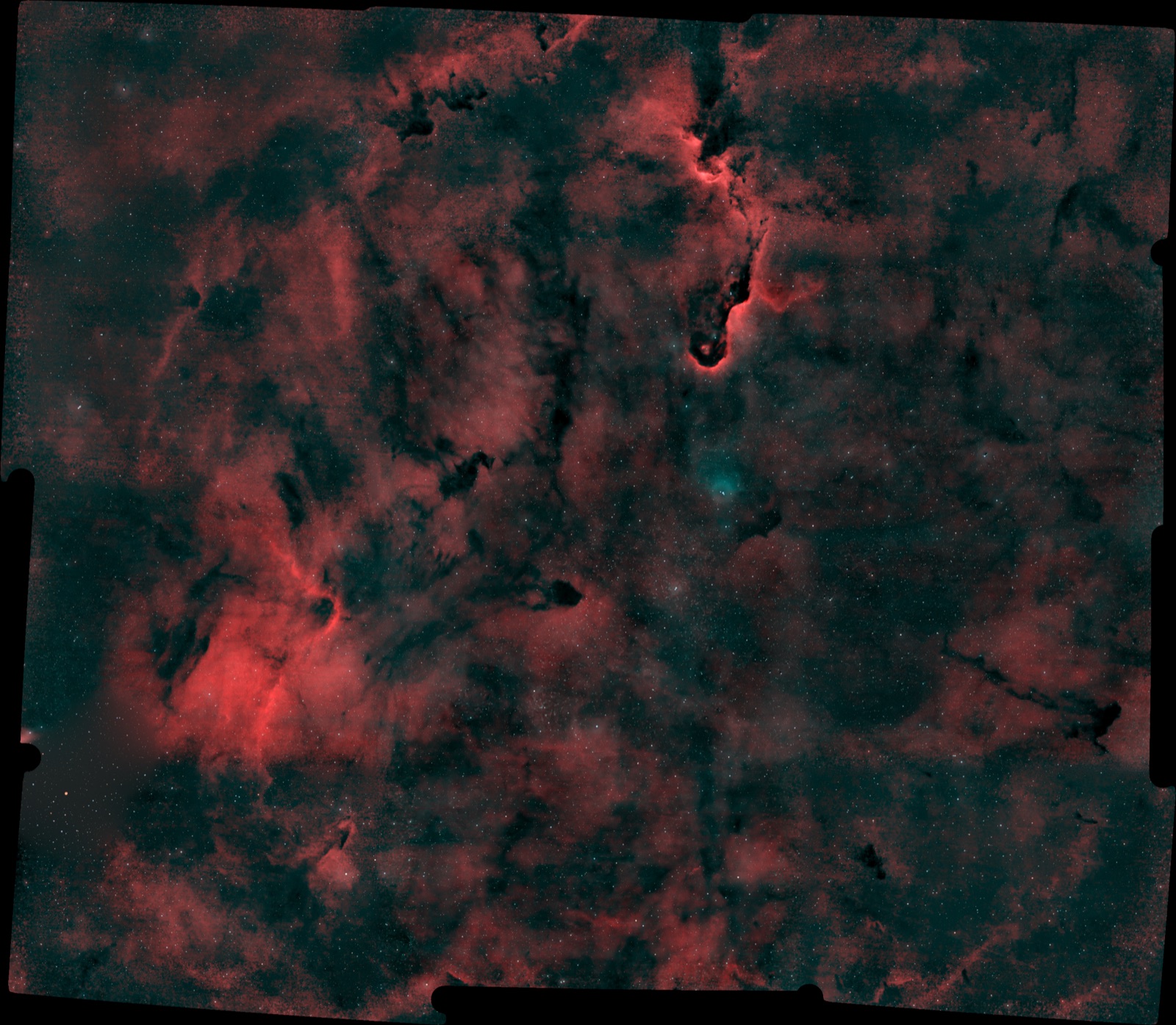
Mit den neuen Feldern habe ich eine erste Fassung des ganzen Mosaiks gerechnet. Es misst 12 188 × 10 632 Pixel, das sind rund 130 Megapixel. Die XISF-Datei hat drei Farbkanäle mit 32 Bit Fließkomma und ist 1,55 GB groß. Die Vorschau ist verkleinert und ein erster Stand: Die Bearbeitung ist mir noch zu hart, das überarbeite ich. Der türkise Fleck in der Mitte ist nach meinem Wissen eine OIII-Region, die ein Doppelstern zum Leuchten bringt. Er soll bleiben.
Der Morgen
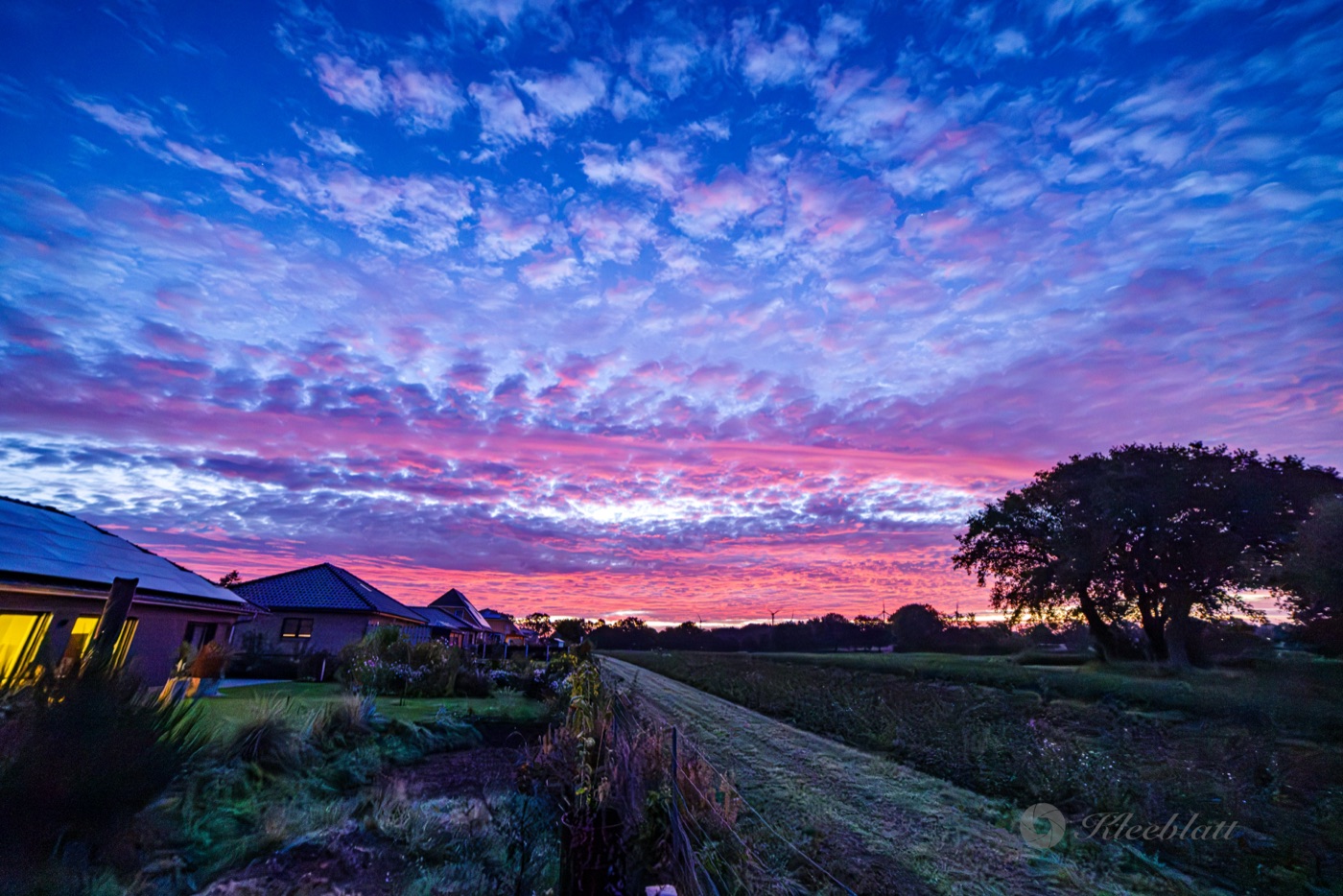
Am frühen Morgen wird man nach so einer Nacht von einem besonderen Licht gegrüßt. Hoch über Vaale standen feine Schäfchenwolken, und am Horizont glühte der Himmel in Rosa und Violett.
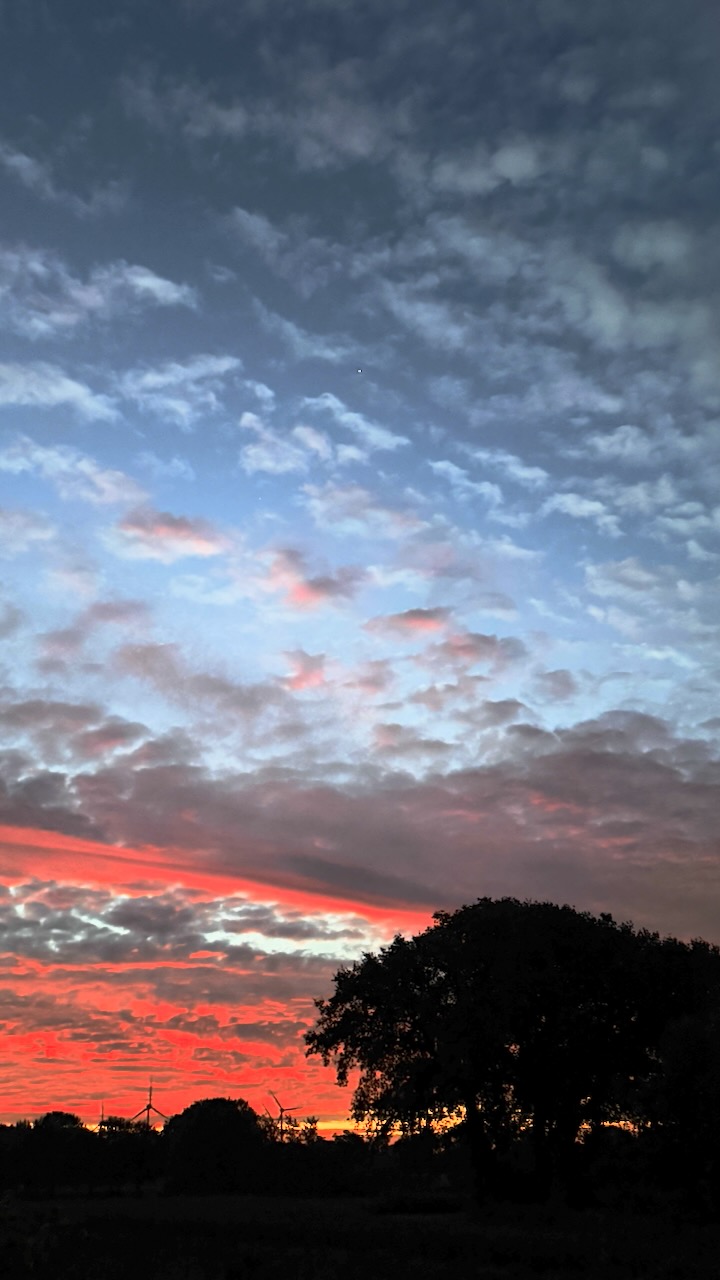
Auf dem zweiten Foto steht als letzter Stern noch Jupiter am Himmel. Es ist der helle Punkt oberhalb der Bildmitte. Darunter glüht der Horizont rot, und rechts steht der Baum als Silhouette.
Was ich mitnehme
- Ein fehlender Messwert ist kein schlechtes Wetter.
- Ein einzelner Fehler darf nicht die ganze Nacht beenden.
- An Sicherheitsteilen ändere ich nichts mehr mitten in der Nacht.
Clear skies,
Marcus
Four times open, four times closed
The second clear night in a row at the Elephant’s Trunk. In the end there were 139 usable frames of 120 seconds each in L-Pro on disk, 4 hours and 38 minutes in total. That means all twelve fields of the mosaic now have data. I was not happy with the technology, though: it cost more time than the weather. Here is the log.
What happened
In the evening the sequence aborted twice, once because of an end contact on the roof that stayed on “moving”, once because of a hanging focuser move. After rebooting the computer at 20:03, four fields of 20 frames each ran cleanly.
At 00:11 my weather watch reported “unsafe” under a clear sky, because the data from the weather station and from the allsky camera dropped out at the same time. Both come through the same Raspberry Pi, whose network connection keeps dropping. The mount parked in the middle of an exposure and the roof closed. After that the filter wheel stopped answering, and the sequence kept exposing with the roof closed. At 01:07 another rain alarm came from a single pulse of the rain sensor at 100 percent humidity. It was not raining.
On top of that came my own interventions in the middle of the night. Every restart of the weather watch counts as “unsafe”, so I triggered two more alarms myself. At 01:38 I reconnected the filter wheel in NINA. From 01:52 the sequence ran until 04:28: field 2, field 3, field 1. In total the roof moved eight times, six of those movements without a reason. You can hear it, and the neighbours do not live far away.
What this means for the software
The software stack still needs quite a bit of rework. Roof control, weather watch and the NINA sequence do not mesh cleanly enough yet. This morning two agents read everything without changing anything and wrote me a long list of improvements. Three things matter most: the exposure loop should watch the safety monitor itself. Short dropouts of a data source must not move the roof. And the filter wheel needs to heal itself. One of my changes from this night, the tolerance for missing weather data, also needs another look.
The mosaic
With the new fields I computed a first version of the whole mosaic. It measures 12,188 × 10,632 pixels, about 130 megapixels. The XISF file has three colour channels at 32-bit floating point and is 1.55 GB. The preview is downscaled and a first state: the processing is still too harsh for me, and I will rework it. The turquoise spot in the middle is, as far as I know, an OIII region that a double star makes glow. It should stay.
The morning
In the early morning, after a night like this, you are greeted by a special light. High above Vaale there were fine fleecy clouds, and the horizon glowed in pink and violet.
In the second photo Jupiter is still in the sky as the last star. It is the bright dot above the centre of the frame. Below it the horizon glows red, and the tree stands on the right as a silhouette.
What I take from it
- A missing reading is not bad weather.
- A single error must not end the whole night.
- I will stop changing safety-relevant parts in the middle of the night.
Clear skies,
Marcus