Saturn, zum ersten Mal
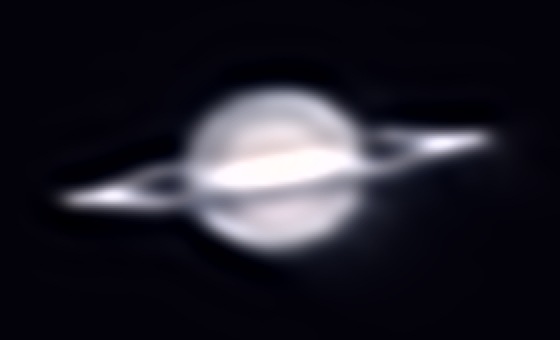
Vor zwei Wochen habe ich hier den Kamerazug für Planeten vorgestellt. Am Samstagabend, dem 14. November, war er zum ersten Mal richtig im Einsatz. Das Ziel war Saturn.
Die Aufnahme
Um 19:10 Uhr habe ich in SharpCap die Aufnahme gestartet: ToupTek G3M678C hinter Barlow und Dispersionskorrektor am Celestron 8". Ausgelesen habe ich einen Ausschnitt von 1920 × 1200 Pixeln, roh in 8 Bit, Gain 800, 100 Millisekunden pro Bild. Nach 20 Minuten waren es 8733 Einzelbilder, gut sieben pro Sekunde, zusammen rund 20 GB.
20 Minuten am Stück sind für ein Planetenvideo lang. Saturn dreht sich in gut zehneinhalb Stunden einmal um sich selbst, in 20 Minuten also um etwa 11 Grad. Bei Jupiter würden die Wolkendetails dabei sichtbar wandern. Saturns Wolkenbänder laufen aber parallel zum Äquator, die Drehung schiebt sie nur in sich selbst weiter. Deshalb verwischt das Bild dadurch kaum.
Die Ringe stehen zurzeit sehr flach. Im März 2025 lagen sie genau in unserer Blickrichtung und waren praktisch unsichtbar, seitdem öffnen sie sich langsam wieder. Auf dem Bild sieht man sie deshalb fast von der Kante als dünnen Strich, der vor der Planetenkugel als heller Streifen vorbeiläuft.
Stacken und Schärfen
Gestapelt habe ich mit LuckyStack, meinem eigenen Programm für Lucky Imaging. Es misst in jedem Bild die Schärfe, nimmt nur die besten und richtet sie in vielen kleinen Feldern einzeln aus, weil die Luft jeden Teil des Bildes etwas anders verbiegt.
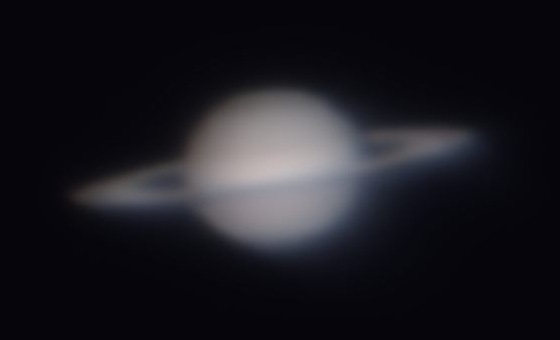
Das Ergebnis ist zunächst weich. Erst das Schärfen holt die Details heraus: Weißabgleich, eine Entfaltung mit 45 Durchgängen, danach Wavelets für die feinen Strukturen und etwas mehr Farbsättigung.
Auf der geschärften Fassung sieht man den Ring, helle und dunkle Bänder auf der Kugel und eine dunklere Polregion. Man sieht aber auch, wo das Schärfen an seine Grenze kommt: Um den Planeten liegt ein dunkler Saum, ein typischer Nebeneffekt von starkem Schärfen.
Was ich mitnehme
Für den Anfang bin ich zufrieden. Mit 100 Millisekunden habe ich aber noch deutlich länger belichtet, als für Lucky Imaging gut ist. Beim nächsten Mal will ich kürzer belichten und dafür mehr Bilder pro Sekunde aufnehmen. Saturn steht hier im Norden außerdem nicht sehr hoch, die Luft vor ihm ist entsprechend unruhig. Jupiter steht in diesem Winter deutlich höher, er ist der nächste Kandidat.
Nach Saturn ging die Nacht mit der Deep-Sky-Kamera weiter, an NGC 1333 im Perseus. Das Bild davon ist jetzt in der Deep-Sky-Galerie.
Clear skies,
Marcus
Saturn, for the first time
Two weeks ago I introduced the planetary imaging train here. On Saturday evening, 14 November, it was properly in use for the first time. The target was Saturn.
The capture
At 19:10 I started the capture in SharpCap: ToupTek G3M678C behind the Barlow and the dispersion corrector on the Celestron 8". I read out a 1920 × 1200 pixel region, raw 8-bit, gain 800, 100 milliseconds per frame. After 20 minutes there were 8733 frames, a little over seven per second, about 20 GB in total.
Twenty minutes in one go is long for a planetary video. Saturn rotates once in a little over ten and a half hours, so in 20 minutes it turns by about 11 degrees. On Jupiter the cloud details would visibly move in that time. Saturn's cloud bands, however, run parallel to the equator, so the rotation only slides them along themselves. That is why the image hardly blurs from it.
The rings are very flat at the moment. In March 2025 they lay exactly in our line of sight and were practically invisible; since then they have slowly been opening again. In the picture they are therefore seen almost edge-on as a thin line that crosses in front of the globe as a bright band.
Stacking and sharpening
I stacked with LuckyStack, my own program for lucky imaging. It measures the sharpness of every frame, keeps only the best and aligns them in many small patches individually, because the air bends each part of the image a little differently.
The result is soft at first. Only sharpening brings out the detail: white balance, a deconvolution with 45 iterations, then wavelets for the fine structures and a bit more colour saturation.
The sharpened version shows the ring, light and dark bands on the globe and a darker polar region. It also shows where sharpening reaches its limit: there is a dark rim around the planet, a typical side effect of strong sharpening.
What I take away
For a start I am happy. With 100 milliseconds, though, I exposed considerably longer than is good for lucky imaging. Next time I want to use shorter exposures and record more frames per second instead. Saturn also does not rise very high up here in the north, so the air in front of it is restless. Jupiter is much higher this winter; it is the next candidate.
After Saturn the night went on with the deep-sky camera, on NGC 1333 in Perseus. That picture is now in the deep-sky gallery.
Clear skies,
Marcus